The Resilient Garden 🌧️
According to the meteorologists, 2026 has seen the wettest start to a year on record for the UK. Following on from last summers drought, this has created a veritable odyssey of running repairs and wholesale replants for us.
Whilst Odysseus had to steer between Scylla and Charybdis, we have been caught between the opposing problems of wet and dry. We have mostly well drained soil here. Very well drained. Except for a heavier section at one end. The end where - oddly enough - we lost a lot of skimmias plus a sizeable conifer to the drought and where, now, we appear to have lost the skimmia replacements, ie some transplanted Choisya ‘White Dazzler’, to the wet.
As discussed in the October newsletter, we vacillated mightily over moving these in the autumn and we appeared to have pulled it off until late February into March this year when they began to turn progressively browner. I’m blaming the wet because the one we moved within the better drained area of their original siting is fine.
To replace them, we settled upon some undistinguished but ‘best bargain’ 3ft Elaeagnus ebbingei ‘Compacta’ that would at least reflect the nearby E. ebbingei hedging which grows apace in the same area and appears enthusiastic and indestructible. We are supporting them with some similarly compact but robust aucubas in the self-fertile selection ‘Rozannie’, already at a nicely bushy 2ft. The aucuba berries will be picked up colourwise by three Photinia x fraseri ‘Little Fenna’. Currently just out of 2 litre pots, they may one day make around 3ft.
Adjacent to these, Sarcococca confusa provides further small shrub support and some handsome Polystichum polyblepharum ferns will make a frontline herbaceous contribution. In the relative murk at the back where there is a shady seat under a big magnolia, some unloved bergenia ‘divisions’ that have been lurking in pots for years are getting a do or die opportunity amongst some indestructible Dryopteris filix-mas and, within the bed, the tall royal fern Osmunda regalis will hopefully rise elegantly upwards to relieve the stodginess of the Elaeagnus and the backing boundary of common laurel.
In locations like this, ferns are incredibly useful. They were amongst the first plants to develop around 400 million years ago, well before grass and flowering plants appeared. My planting and design predilections being what they are, I’d find it hard to garden without them. They furnish awkward shady spots with particular grace and many of the most useful ones are ‘winter green’, if not classically evergreen. The Victorians popularised them as garden plants and it was due to a semi-abandoned but fascinating section of a Victorian woodland garden (into which I used to sneak as a child) that they were able to colonise my psyche.
It’s amazing just how many times they provide the fallback position. The pond had to have a new liner this winter - it was a nightmare job for poor Andrew. This pond is naturally filled from the aquifer which arises, spring like, at the bottom of a slope, fills two viviers and then overflows to create the pond. If it has been too dry for overflow we top up the pond from a hosepipe attached to the spring pump in the backyard.
Yet for all of the water contributed by the aquifer beneath, the pond is surrounded by well drained soil that won’t support classic boggy edge planting. Not enthusiastic enough about bog plants to create a boggy area, we hope that a new and inauspicious looking bare patch that is jammed between the pond and a thuja boundary will be colonised by the ostrich fern, Matteuccia struthiopteris. This is stoloniferous and can run quite aggressively when suited. It’s unlikely to be well suited in this particular location but l’m optimistic about its managing a level of growth that will serve us.
NB If you are going to have only one fern in your garden and you intend to actually look at it as opposed to using it as a utility plant, then choose the previously mentioned Polystichum setiferum ‘Pulcherrimum Bevis’.
Though all of this sounds potentially dull ie lots of boring green stuff, things are about to become very colorful in the potager where pot marigolds in orange and yellow, blue cornflowers, red geums (Mrs Bradshaw and Firestarter) purple sage etc have been planted out. A jolly selection of salad leaves reared in a polytunnel in gutter pipes (as recommended by Sarah Raven) will be presently slid out and firmed into the raised bed between the lines of calendulas.
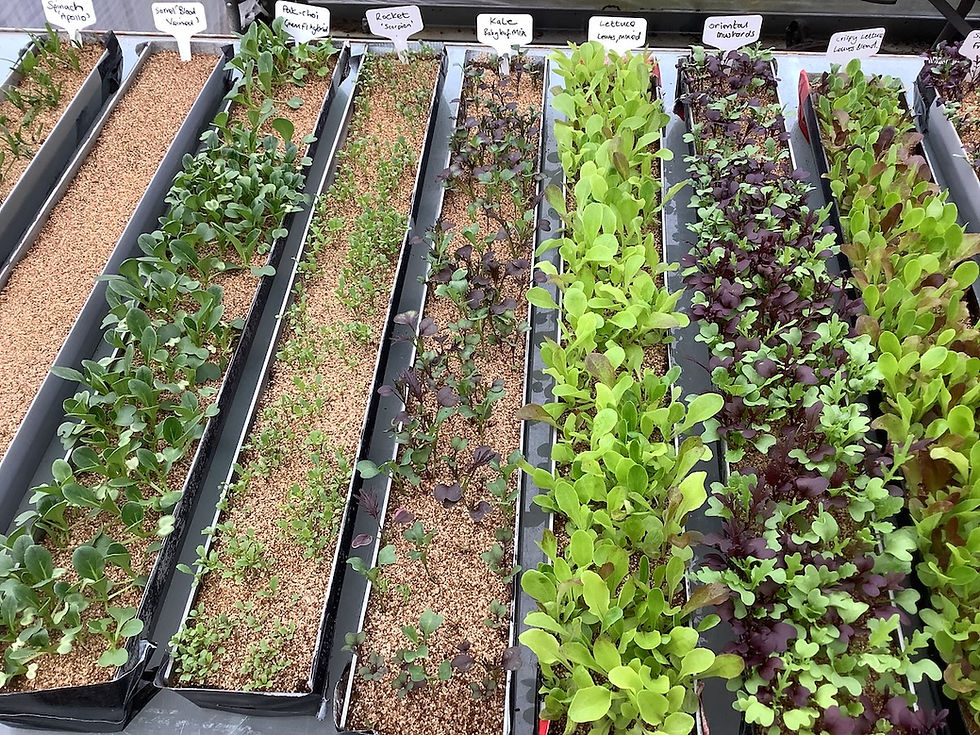
Salad seedlings in gutter pipes, late March.
The potager is always in primary colours - I think of it as a Peter Rabbit space where one can indulge a certain childish lack of taste.
Unfortunately, thoughts of Peter Rabbit are marred by the fact that he insists on visiting in person and eating whatever is most recently planted. And if, after initial investigation, it isn’t to his fancy, he just digs all round it leaving the roots exposed.
And there are a lot of Peter Rabbits this year. Does that idle Mr Tod do nothing but poop on the lawn?
The dog catches and kills more rabbits than Kim can stomach but there are still holes and chewed plants.
Unfortunately, with sculptors coming and going and couriers bringing plants that I’ve ordered, the main gate is left tantalisingly open. I just hope the rabbits don’t acquaint the muntjac and roe deer in the field with this unfortunate open door situation. But, any minute now …. A stag’s horn sumach we just planted on the edge of the pinetum was barked within twenty four hours. A new tree amongst several hundred older ones was found faster than Andrew could find the mislaid tree guards!
I never quite understand why garden journalists and designers are promoting wildlife gardens so enthusiastically. In my experience, you can have wildlife or you can have the garden you actually want. It can be difficult to have both. Unless you’re just talking bees.
For two years running, rats stole all the tulip bulbs out of the pots - wire netting covers notwithstanding. When I gave up on bulbs in pots, they ate a hole in the back door. I don’t know if they were cross about the bulbs or trying get at the dog food in the lobby.
I recently noticed a podcast on YouTube by Alan Titchmarsh called something like, ‘How to get rid of the rats in your garden.’ Seems to me that the cognoscenti of the horticultural world should not have kept telling us to build log piles to shelter ‘small mammals’. I warned them. I shouted at the TV : ‘They’re called rats!’ As for the other ‘small mammals’ - a plague of voles one year finished off some serious and expensive clematis ambitions I’d been indulging.
Nor can my baby frog fetish be satisfied because mallard ducks from the river eat all the frogspawn, tadpoles etc. Jemima Puddle Duck is spoiling everything. Even the goldfish in the ornamental pond in the Sunk Garden are getting thinned out. In this, Jemima is aided and abetted by a heron.
I had a forlorn hope lodged with Mrs.Tiggy Winkle who, last year, eschewed an expensively classy hedgehog house and gave birth under the oil tank. But no sign of the Tiggy Winkles as yet. I imagine they’re planning a mass drowning event to launch the refurbished pond.
So there we are: the dog is killing rabbits and making Kim feel sick, Andy is wandering around with a knapsack sprayer full of ‘Grazers’ rabbit and deer repellent and a squadron of furiously squawking Jackdaws is divebombing the soffit boards because we’ve blocked up their access to the roof space where they used to nest. Before they moved into the neighbourhood, we had house martins. So much for the balance of nature. If you’re a balance of nature enthusiast you need to have a chat with Squirrel Nutkin who was distinctly red, as I recall.
I certainly don’t see nature balancing out in our microcosm here without the apex predator getting out the shotgun. Alternatively, I could just make a television programme about it because I’m sure that none of this ever happens to Monty Don or Chris Packham.


Comments